
What Is Flexographic Printing? How It Works on Film
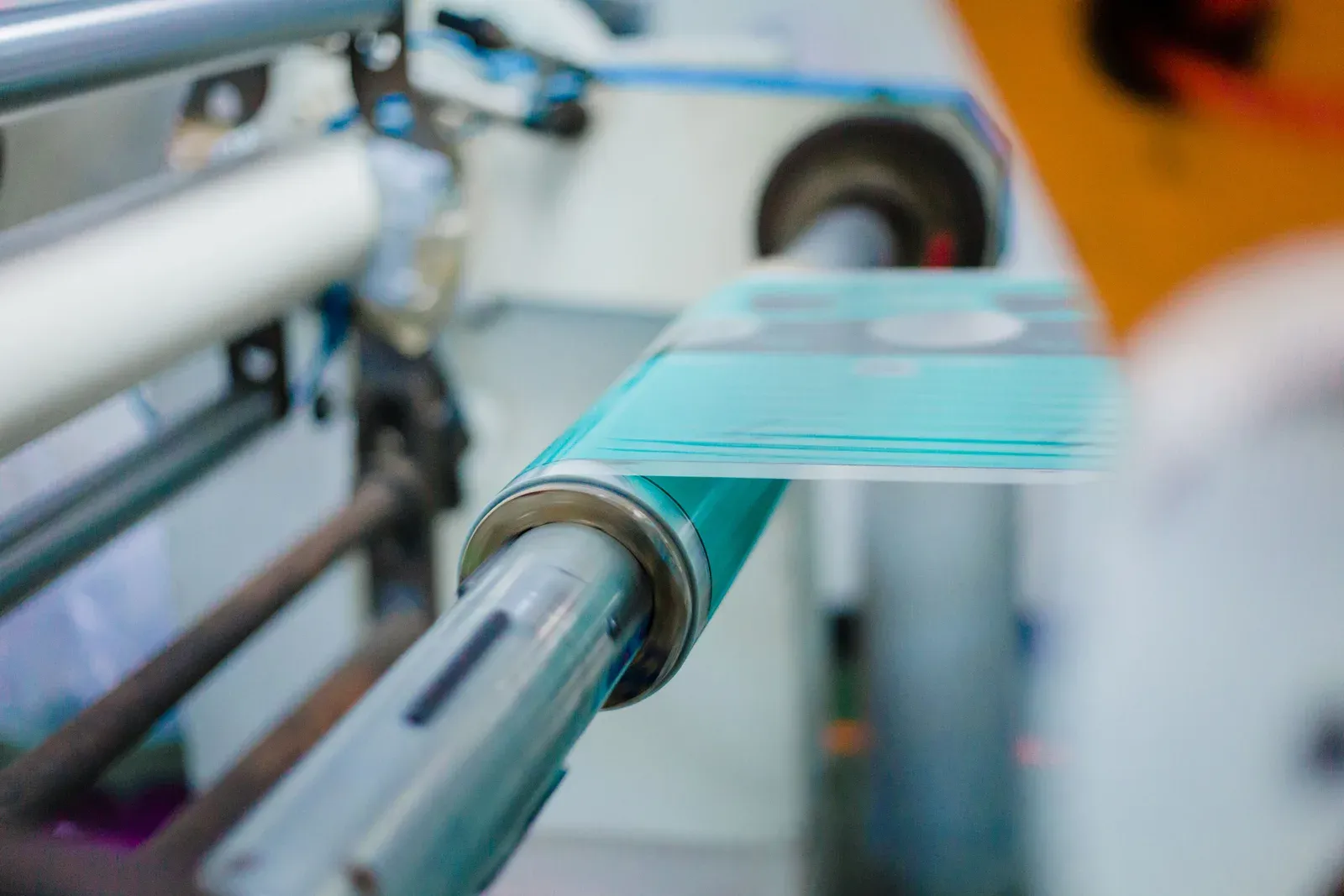
Brand artwork on flexible packaging is almost always applied by flexographic printing. It differs from the offset printing familiar from paper, and the reason is straightforward: packaging film does not behave like paper.
This article explains how flexographic printing works, where it parts company with offset, and why it is the method used on bags and film reels. At the end we set out what applies in DEKA Plastik’s own printing process.
What is flexographic printing?
Flexographic printing is a relief process in which raised areas on a flexible plate transfer ink directly onto the substrate. The plate is mounted on a rotating cylinder and the material is printed as it passes between rollers.
What sets the method apart is that the plate is flexible. That allows printing not only on flat, absorbent stock but on plastic film, paper, metallised foil and even fabric (source). This is the first reason it dominates packaging: most packaging substrates are not paper.
How does a flexographic press work?
Flexographic presses are usually rotary: film enters as a reel, is printed as it passes between cylinders, and is rewound (source).
The number of colours is set by the press’s unit count. Flexographic presses are built as multi-colour machines — six, eight and ten-unit configurations are common — with each colour running through its own unit (source). The colour count in a design therefore determines both how many plates are made and how many units are needed. Where water-based inks are used, drying ovens also have to be built into the line (source).
What does the printing plate do?
The plate carries the artwork and in flexographic printing is typically made of rubber or photopolymer, with the design imaged onto it digitally (source).
Each colour needs its own plate. That single fact governs the economics: a plate is made once and used for the duration of the job, so its cost is spread across the run length. Repeat orders of the same artwork can reuse the plate; changed artwork requires a new one.
This is why flexographic printing is efficient for high-volume, repeating work (source), and why very short one-off runs carry a proportionally higher set-up burden.
What is the anilox roller for?
The anilox roller meters the ink. Micro-cells on its surface pick up ink and deliver it to the plate as an even film (source).
Colour consistency across a long run depends heavily on this. If the delivered ink volume drifts, colour drifts with it; the anilox is what holds that variable steady.
How does flexographic printing differ from offset?
The core differences are the plate and the printable substrate. Offset uses metal plates and is mainly suited to paper-type materials, while flexographic printing uses flexible photopolymer plates and prints on plastics, paper and metallised foils (source).
Inks differ too: offset uses oil-based inks, while water-based inks are commonly used in flexographic printing (source).
In practice the question is simply what are you printing on. Books, brochures and paper labels are offset territory. Bags, film reels and flexible packaging are printed flexographically.
Why is flexography used for bags and film?
Packaging film is flexible, non-absorbent and processed in reel form, and flexographic printing suits all three: the plate flexes, the ink system is chosen for non-absorbent surfaces, and printing runs reel-to-reel as a continuous process.
The production sequence requires it as well. Film is extruded or sourced first, then printed, then either cut and sealed into bags or slit and rewound to the width your line needs. Printing has to happen in the middle of that chain, while the material is still a reel — which is precisely what flexographic presses are built for.
What do you decide when ordering printed packaging?
Decisions on printed packaging are made independently of one another: colour, film, dimensions and finish are each chosen separately. Thinking them through one by one before approaching a supplier makes the process easier.
Colour count comes first. Since flexographic printing needs a separate plate per colour, the number of colours in the artwork drives the set-up side directly. Where printing is not needed at all, an unprinted option exists.
Film is the second decision and it is independent of printing. Whether polyethylene, OPP or CPP is used follows from what the product itself requires; printing does not change that choice.
Dimensions and finish are the last two. On reel products, width, diameter and micron are set per order and the reel is wound to the dimensions your packaging machine requires; the surface can be gloss or matte.
When requesting a quotation, the useful information is: the artwork file and its colour count, which film is to be used, the width and diameter your machine requires, and the quantity you need. Even if the artwork is not final, film and dimensions can be assessed on their own; the printing decision can follow later.
What applies at DEKA Plastik
At DEKA Plastik, printing is applied in our own facilities by flexography, in up to eight colours. Where printing is not required, the same products are produced unprinted.
The recorded specifics are these:
- Which film is printed. Polyethylene film is produced in our own extrusion; OPP and CPP film is sourced from approved suppliers. Printing and slitting are carried out in our own facilities.
- Management systems. Production runs under ISO 9001:2015 quality and ISO 22000:2018 food safety management systems.
Printing is a brand identity decision; film and dimensions are decided separately. Where printing is not needed, the same film and dimension options apply to unprinted rolls.
If you need printed film reels, the full specification — width, diameter, micron and print options — is on our printed rolls page; use our contact page to send your dimensions.